11.15.2012

Anxiety in Athletes

Interesting New York Times article on golf pro Charlie Beljan's panic attack during his win at a PGA Tour event. This situation-specific anxiety is probably vastly more wide-spread than we think. Our world is awash in idolatrous jock-worship and so much sports writing focuses on drive, work, physical prowess and, when the athlete is successful, their mental toughness. I wonder how many physically gifted people have stepped away from competition because, frankly, it can be emotionally fraught.

Personally, I think I know what Beljan might be experiencing. As a teenager, I was a modestly-talented skier (back when Jean-Claude Killy ruled), skied regularly as a ski patrolman with a coach for the Olympic B team (very helpful to my skills) and a small New England college talked to me about joining their team. Given my limited interest in athletics overall, I gave it all a pass. Even at the time, I had what I think was a fair understanding of how competition wasn't going to be good for me. First, attention and concentration issues meant that maintaining 100% focus in a race course was tough (disastrous in slalom, deadly in downhill). But the killer was anxiety, something I had experienced much younger in chess matches. If you suffer from the smallest imbalance in the sympathetic nervous system, competition (effectively the fight side of fight-flight-freeze) can be way too charged. Skiing is not a risk-averse sport in general, with lots of speed, height and danger. For me, that was peachy (after all, I had an adolescent brain)—it was the competing that sucked. Maybe an anxiolytic could have helped, and apparently the World Anti-Doping Agency (WADA) doesn't include them on the banned substances list. (Ah, what might have been.)

Also intriguing is how Beljan managed to make it this far in his career without his anxiety overwhelming him. One player interviewed in the article wondered why such scenes don't happen more often. I suspect, from my experience, that nearly all people select themselves out of sports fairly early. Take it from me, the body and mind send signals starting at a young age that you aren't suited for this kind of stress, no matter if you are capable physically.

11.14.2012

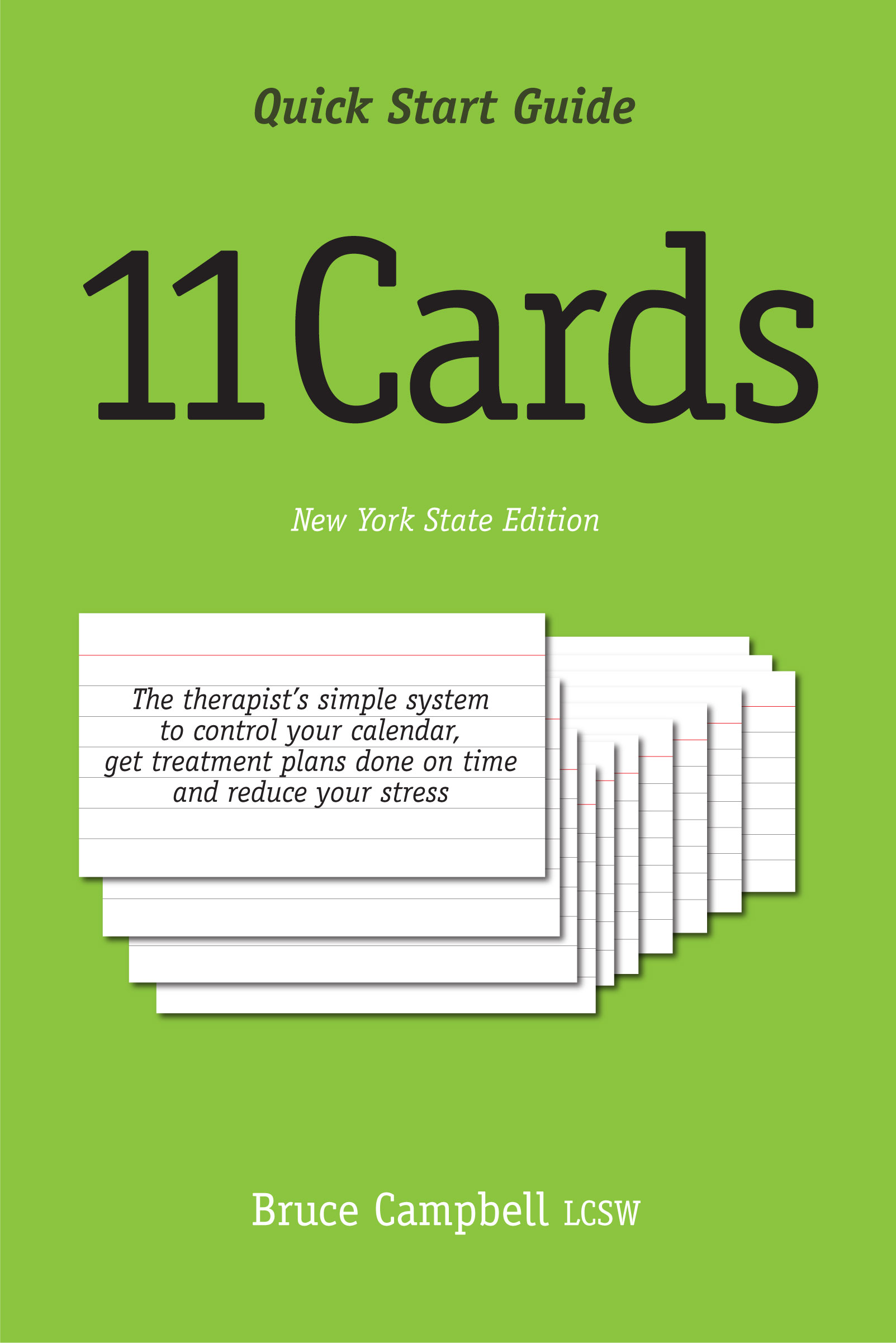
11 Cards: Quick Start Guide

I work in a mental health clinic in New York City. The patients are great, the staff are great. The darkest challenge, though, is the management of treatment plans. The Office of Mental Health for the State of New York (all bow before its name) requires that every patient get a treatment plan written within 30 days of admission and reviewed at least every 90 days thereafter. So, with 50 patients (active or inactive), that's in excess of 200 plans/reviews handled a year per clinician, effectively 4 per week. Time management is a bear. 

With that in mind, I needed a way to manage this relentless schedule and not let the management overwhelm my care for my patients (or my natural ADD). I found an elegantly simple solution, so I wrote a short e-book describing it. Buy it if you're an overworked, overstressed clinician (or know one). Let me know what you think.

11.13.2012

Finally, the patients get flowers

No matter how sane you tell yourself you are, when the door closes behind you as a visitor on the psychiatric ward, you feel a shudder. These are sterile, hard-edged environments. Nice to see this art project by Anna Schuleit at the closing Massachusetts Mental Health Center, one of the old school hospitals. Schuleit covered the facility in fresh flowers because flowers were off-limits when it was a functioning facility. 28,000 plants for 28,000 estimated patients for the 91 years of operation.

10.18.2012

Don't try this at home

This is an amusing way to deal with the perfect storm of 100% Internet and ADHD: hire someone to slap you if you start wandering off task. The serious message may be the aspect of subtle social pressures to maintain focus. I spend most of my day (when I'm not seeing patients) alone in front of my computer. I have to use intrinsic rather than extrinsic motivators.

12.22.2011

The Iron Rule-out of Mental Health Symptoms: "It's never the marijuana"

It's been a while since I heard it, but a patient today uttered the immortal phrase "It's not the marijuana" because (like Dr. House's Lupus): "It's never the marijuana." Trouble sleeping? Maybe it's the coffee, or the late night TV, or the wife, or the light, or the diet, or the depression. It can be any of a dozen things. What about the 2 joints a day? Oh? Sorry, it can never be the marijuana: "I'll change anything else, but I won't change that. It's not the marijuana." Right.